

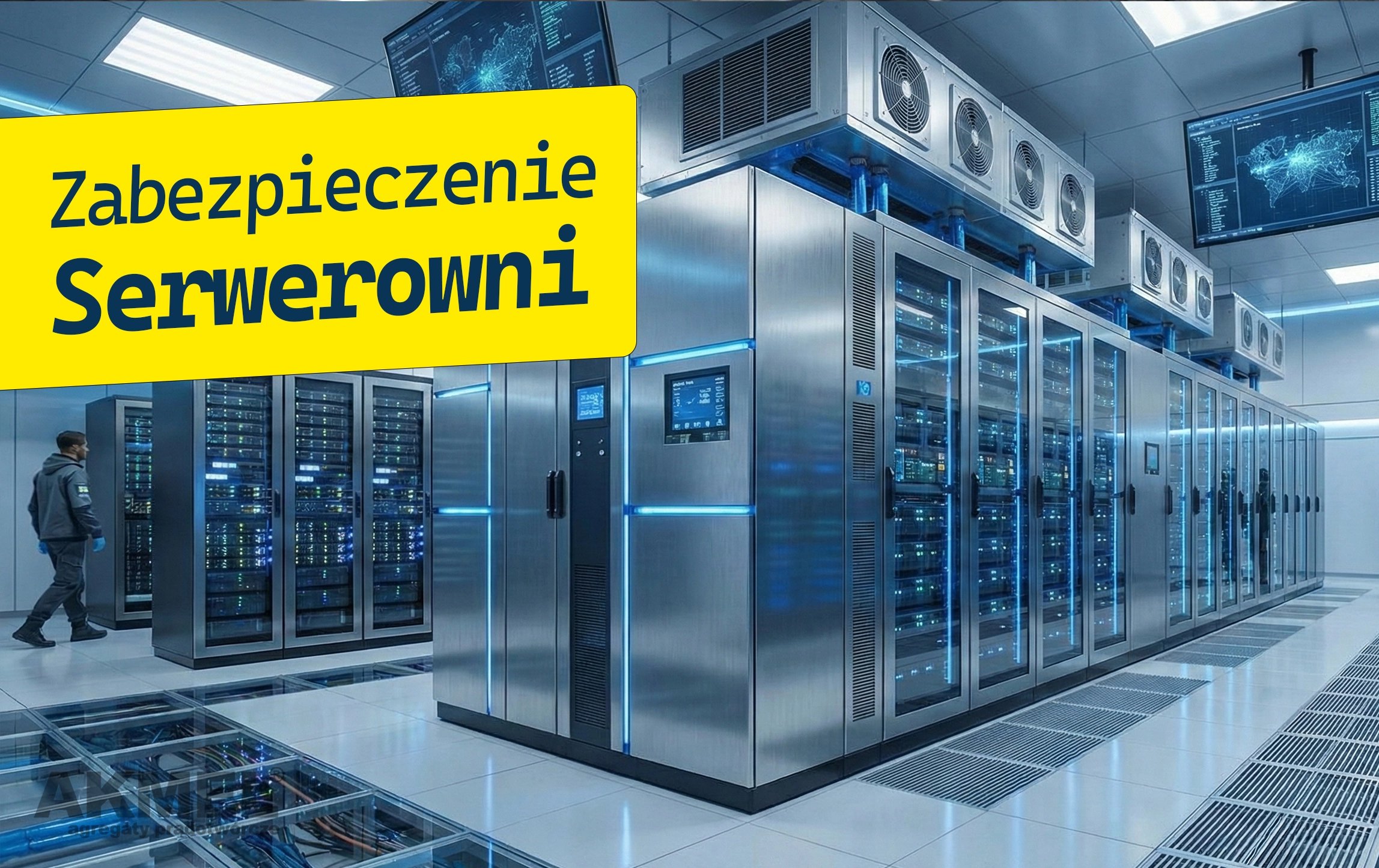
A power outage is one of the most serious threats to the continuity of IT infrastructure. Whether we are talking about an on-premise local server room, a private data center (private cloud), or a hybrid environment, an unplanned power cut can result in service downtime, data and equipment loss, and high costs for the organization.
Introduction
A power outage is one of the most serious threats to the continuity of IT infrastructure. Whether we are talking about an on-premise local server room, a private data center (private cloud), or a hybrid environment, an unplanned power failure can result in service downtime, data and equipment loss, and high costs for the organization. Therefore, it is crucial to design a backup power system that protects the server room from the consequences of power loss. In this article, we discuss the technical aspects of such a system – including the role of UPS units, generators with automatic transfer switches (ATS), power quality requirements (G3 class, voltage and frequency stabilization), and compliance with design standards such as TIA-942 and Tier levels.
UPS Systems – the First Line of Defense
A UPS (Uninterruptible Power Supply) is the fundamental element protecting a server room from sudden power outages. Its task is to immediately take over the power supply to connected equipment when the utility power fails, in order to maintain continuous operation of servers, network devices, and storage systems until main power is restored or the backup generator is started. In addition, a UPS filters and conditions electricity – it protects equipment against surges, brownouts, noise, and short disturbances in the grid, delivering “clean” and stable power with proper parameters. In practice, a UPS prevents uncontrolled server shutdowns and data loss, while also extending the lifespan of sensitive components by eliminating voltage spikes and fluctuations. |


UPS Topologies
There are three basic types of UPS systems, differing in their operation and level of protection:
- Offline (standby): The simplest type, which remains on standby as long as input voltage is within the acceptable range. In case of a failure or significant drop, the UPS switches to battery. The switching time (a few to several milliseconds) causes a brief interruption in power supply. Offline UPS is suitable for less critical applications due to this delay and lack of active voltage regulation.
- Line-interactive: Equipped with an Automatic Voltage Regulation (AVR) system operating while on utility power. It corrects moderate voltage fluctuations without switching to battery, improving resilience to disturbances and extending battery life. In case of a serious anomaly or outage, it switches to battery similar to offline UPS (with a short delay). Suitable for environments with frequent disturbances but rare full outages – e.g., small server rooms and telecom racks.
- Online (double conversion): The most advanced and recommended UPS type for critical server rooms. It operates in continuous double conversion mode – AC power is converted to DC and then back to clean AC supplied to equipment. IT devices are fully isolated from disturbances, and there is no transfer time during an outage (since the UPS already powers loads through the inverter). This UPS ensures the highest level of protection against all anomalies. According to IEC classification, it is defined as a VFI (Voltage and Frequency Independent) UPS – output voltage and frequency are independent of input parameters. Although traditionally less efficient and hotter, modern online UPS units achieve >95% efficiency (up to ~99% in eco mode). Double conversion is the standard in large data centers where uptime is critical.
UPS systems are sized according to the load of protected equipment and required autonomy (battery runtime). In a typical server room, 5–15 minutes is sufficient – batteries ensure continuity until the generator starts or systems are shut down safely. Larger data centers often use modular and redundant systems – e.g., multiple UPS modules in parallel (N+1 redundancy) or even two independent UPS systems for dual power paths. Modular designs also allow easy scalability. Another trend is the replacement of VRLA lead-acid batteries with lithium-ion batteries in UPS applications. Li-ion batteries offer higher energy density, longer life, and shorter charging times, though they require advanced BMS and strict fire safety compliance. Nevertheless, the core role of a UPS remains unchanged – it is the first line of defense, providing a few minutes of seamless power and stable electricity for critical equipment.
Generator and ATS – Long-Term Power Supply
|
Another key element of server room power protection is the generator (backup power source), which supplies electricity during prolonged outages. Typically, stationary diesel generators of appropriate power are used – from a few kW for small IT nodes to several MW (with multiple parallel units) in large data centers. A crucial component is the ATS (Automatic Transfer Switch), which monitors the utility supply and, in case of failure or severe drop, immediately starts the generator and switches loads once it stabilizes. ATS enables fast and reliable startup – generator power can be delivered within a few to several seconds, typically less than a minute. In Tier III/IV data centers, multiple parallel generators ensure redundancy. Generators are regularly auto-tested (weekly/monthly) to verify readiness. In prolonged outages, the generator becomes the main power source for hours or days, limited only by fuel availability. Together with UPS, the generator ensures survival of both short outages and long blackouts. |

It is important to emphasize that UPS and generator work complementarily – UPS instantly bridges the gap, while the generator takes over once running. The UPS then recharges using generator power. This tandem creates virtually unlimited backup time – UPS autonomy bridges generator startup time. Such hybrid setups are now standard in critical facilities, from small server rooms to large data centers, provided all components are properly sized and integrated.

Backup Power Quality – G3 Class, Voltage and Frequency Stabilization
Having a generator does not guarantee power suitable for sensitive electronics. The quality of generated electricity is crucial – voltage stability, frequency, and sine waveform. The ISO 8528-5 standard defines generator classes G1–G4. For IT and telecom, at least G3-class generators are recommended, providing stable voltage, clean sine wave (low THD), and precise frequency control (e.g., 50 Hz ±0.5%). These parameters often match or exceed grid quality, ensuring IT devices remain unaffected during generator operation.
This is achieved with modern regulators: an engine speed governor for frequency and an AVR (Automatic Voltage Regulator) for voltage. Digital regulators allow rapid response to load changes. Together, they ensure stable output despite sudden load variations. G3-class generators can handle load steps of 50–70% of rated power with minimal transients. Another key aspect is generator–UPS compatibility: UPS systems (especially double conversion) can draw distorted currents (high THDi). Therefore, generators must be oversized (20–70%) and meet UPS input requirements for voltage, frequency, and low THDu. G3/G4 generators with digital controls provide these parameters, ensuring seamless UPS synchronization and bypass mode compatibility.
Design Standards: TIA-942 and Tier Classification
When designing high-availability server room power, industry standards such as ANSI/TIA-942 and Uptime Institute Tiers provide guidance. TIA-942 defines Rated-1 to Rated-4, equivalent to Tier I–IV, describing redundancy and availability levels. Key differences:
- Tier I (Rated-1) – Basic: Single power path, no redundancy. Typically one UPS and one generator. Any component failure causes downtime. Availability ~99.671% (~28h downtime/year).
- Tier II (Rated-2) – Partial redundancy: Some redundancy (e.g., N+1 UPS, backup generator), but still a single power path. Availability ~99.741% (~22h downtime/year).
- Tier III (Rated-3) – Concurrently maintainable: Full N+1 redundancy, dual power paths. Maintenance without downtime. Availability ~99.982% (~1.6h downtime/year).
- Tier IV (Rated-4) – Fault-tolerant: 2N redundancy, dual active power paths. No single point of failure. Availability ~99.995% (<26min downtime/year). Used in mission-critical sites (banks, stock exchanges, defense).
Compliance with Standards and Best Practices
Meeting Tier requirements should be planned from the design stage. TIA-942 specifies details such as 12h minimum fuel autonomy for Tier III/IV, separate power cabling routes, and redundant UPS modules. Many organizations seek official certification (TIA-942 or Uptime Institute) for credibility. While smaller server rooms may operate at Tier I/II levels, adopting best practices – such as a generator with ATS, redundant UPS, and regular testing – is recommended. Following TIA-942/Tier standards ensures no critical reliability aspect is overlooked.

Summary
Designing resilient server room power requires multiple protection layers. UPS systems serve as the first line of defense, instantly bridging outages and filtering power. Generators with ATS provide long-term supply during blackouts. Generators must meet G3 quality standards, be properly sized, and synchronized with UPS for stable operation. Finally, the architecture should follow recognized standards (TIA-942, Tier I–IV) with redundancy and proven topologies matching required uptime levels.
Investing in robust backup power pays off in reliability. For IT admins – fewer emergencies; for infrastructure designers – SLA compliance; for executives – business continuity. In today’s data-driven world, securing server rooms against power failures is a cornerstone of operational security. A well-designed backup system ensures servers stay online even during prolonged blackouts, protecting critical data. Here, there are no compromises – only multi-layered, redundant solutions validated by standards can deliver the expected protection. A properly secured server room becomes immune to grid instability, ensuring uninterrupted business operations.

Adam Żak
Content prepared based on AKMEL’s experience in the sale, service, rental, and implementation of emergency power supply systems for companies, industry, and institutions.
