Emergency Shelters Ranking & Requirements 2026: Backup Power with Generating Sets
Since 14 July 2025, new regulations have been in force defining the requirements for emergency shelters (Miejsca Doraźnego Schronienia – MDS). One of the key mandatory elements is ensuring continuity of electrical power supply – and this is where generating sets come to the forefront.
What are emergency shelters (MDS)?
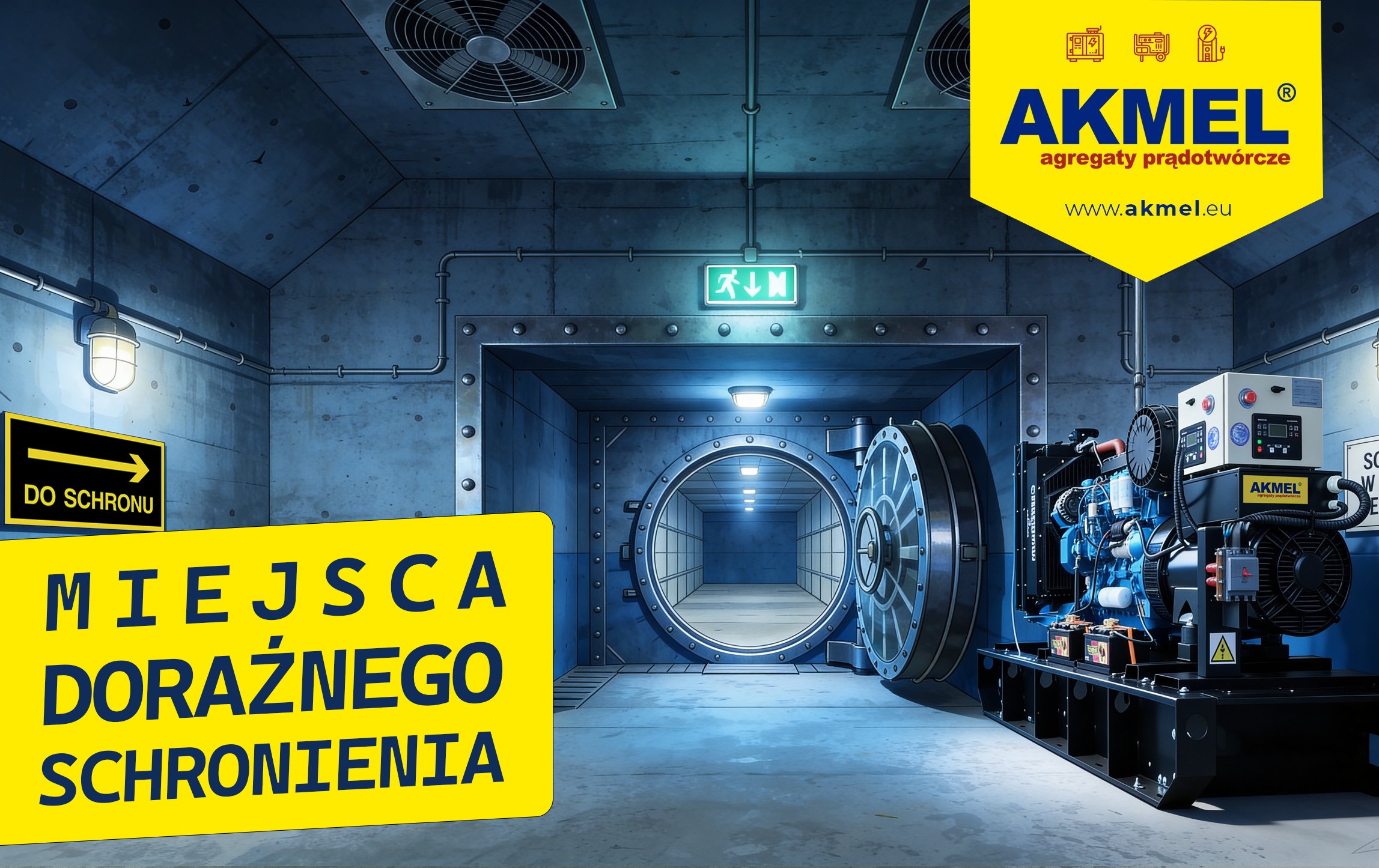
Emergency shelters (MDS) are specially prepared spaces that, in the event of a threat, can provide protection for the civilian population. They can be either rooms in existing buildings (e.g. basements, underground garages, tunnels) or free-standing structures built specifically for this purpose.
Electricity – an absolute legal requirement
The new regulation clearly states that every emergency shelter must be equipped with electrical installations. This is not optional – it is a legal obligation.
What exactly do the regulations say?
According to § 8 of the regulation, each MDS must provide:
✅ Supply of electricity with appropriate technical parameters to all receivers
✅ Artificial lighting of the entire MDS area with a minimum intensity of 50 lx (measured at floor level)
✅ Power supply for ventilation systems – critical for maintaining at least 18% oxygen concentration for a minimum of 48 hours
✅ Power supply for heating devices
✅ Power supply for radio communication reception devices
Why are generating sets essential in emergency shelters?
1. Independence from the power grid
In a threat situation, the power grid may be damaged or deliberately shut down. A generating set guarantees an independent energy source that operates regardless of the condition of external infrastructure.
2. Continuity of critical systems
The generating set ensures power for:
• Emergency lighting – regulations require min. 50 lx across the entire area
• Mechanical ventilation systems – without power there is no fresh air for sheltered people
• Communication systems – receiving messages can be a matter of survival
• Water pumps – access to drinking water
• Heating – especially important in winter
• Access control systems – securing entrances
3. Compliance with legal requirements
Without guaranteed continuity of power supply, a building cannot be approved as an emergency shelter. Owners and managers of facilities must demonstrate how they will provide electricity – and generating sets are the best solution.
What kind of generating sets are needed for an emergency shelter?
Selecting the right power rating according to shelter size
The required generator power depends on the shelter capacity:
MDS for 50 people:
• Lighting (50 lx × ~75 m² area): ~2–3 kW
• Mechanical ventilation: 2–4 kW
• Sanitary facilities: 2–3 kW
• Recommended: 10–15 kVA generator
MDS for 200 people:
• Lighting (50 lx × ~300 m² area): ~8–10 kW
• Mechanical ventilation: 5–8 kW
• Sanitary rooms, pumps: 5–7 kW
• Heating devices: 10–15 kW
• Recommended: 30–40 kVA generator
MDS for 300 people (maximum):
• Comprehensive power supply systems
• Recommended: 50–80 kVA generator or multiple-unit system
Key technical parameters of a generating set for MDS
✅ Automatic start (ATS) – every second counts in a crisis
✅ Long operating time – minimum 48 hours of continuous operation (large fuel tank)
✅ Low noise level – especially important in underground facilities
✅ Highest reliability – top-class engines (e.g. Perkins, Cummins, Volvo)
✅ Resistance to harsh conditions – protection against moisture and dust
✅ Monitoring system – remote supervision of operating parameters
✅ Container enclosure – protection against weather and external factors
Akmel generating sets – proven solutions for emergency shelters
Why do clients choose Akmel?
🔧 Comprehensive service – from power selection, through installation, to service
⚡ Fast delivery and installation – we understand the urgency
🛡️ Generators resistant to harsh conditions – proven in the toughest situations
📞 24/7 technical support – because safety never waits
🎯 Experience in strategic projects – installations for critical infrastructure facilities
Our recommendations for MDS
|
For small shelters (15–50 people): • Compact 10–20 kVA generators |
For medium shelters (50–200 people): • 20–40 kVA generators |
For large shelters (200–300 people): • 50–100 kVA generators or modular configuration |
What should owners and managers of MDS buildings know?
Obligations arising from the regulations
1. Preparation of technical documentation – must include the method of ensuring electricity supply
2. Assessment of the existing electrical installation – is the current installation sufficient?
3. Emergency power plan – a generating set is a must-have
4. Preparation of the installation site – the generator requires proper location
5. Provision of service and maintenance – the generator must always be ready to operate
Common mistakes when planning emergency power for MDS
❌ Underestimating power requirements – generator too weak for actual needs
❌ No automation – manual start in a crisis may be impossible
❌ Too small fuel tank – regulations require at least 48 hours of operation
❌ Wrong generator location – in a hazard zone or without service access
❌ No service plan – non-functional generator = failure to meet requirements
Implementation schedule with Akmel – act now!
Phase 1: Needs assessment (1–2 weeks)
• Analysis of planned MDS capacity
• Calculation of power demand
• Determination of generator location
Phase 2: Solution selection (1 week)
• Consultation with supplier (Akmel)
• Selection of appropriate generator
• Quotation and contract
Phase 3: Installation (2–4 weeks)
• Preparation of installation site
• Delivery and installation of generator
• Connection to building electrical installation
• ATS automation configuration
Phase 4: Testing and acceptance (1 week)
• Load tests
• Automatic transfer tests
• Operator training
• Acceptance documentation
Phase 5: Operation
• Regular service inspections (every 6 months)
• Emergency tests (every quarter)
• Fuel refilling
• Parameter monitoring
Free-standing emergency shelters – power supply there too!
The regulations also provide for the construction of free-standing shelters (anti-aircraft slit trenches, dugouts). Although simpler in construction, they also require lighting and ventilation.
For free-standing MDS the ideal solutions are:
• Mobile generators – easy to relocate
• Compact models – space-saving
• Enclosed versions – protection against weather conditions
• Low power consumption – 5–10 kVA is sufficient for small shelters
Costs – an investment in MDS safety
Estimated costs of a generator for MDS:
15 kVA generator (up to 50 people): PLN 25,000 – 35,000
40 kVA generator (up to 200 people): PLN 40,000 – 55,000
80 kVA generator (up to 300 people): PLN 60,000 – 75,000
Additional costs:
• Installation and mounting: price depends on site conditions and scope of work
• ATS automation: PLN 2,500 – 5,500
• Annual service: PLN 2,000 – 3,000
This is not a cost – it is a real investment in:
✅ Compliance with legal requirements
✅ Safety of occupants / employees
✅ Property value
✅ Peace of mind for owners / managers
Have additional questions? Need a quotation?
Akmel – experts in emergency power supply will advise you how to:
• Select the right generator for your MDS
• Plan the installation in accordance with regulations
• Carry out full implementation
• Provide service and maintenance
Don’t wait for a crisis – prepare today!
Summary
The new regulations on emergency shelters impose clear requirements for mandatory provision of electricity. Without a reliable power supply system – including a generating set as a backup source – the facility will not meet the requirements and will not be approved as an MDS.
A generating set is not an extra – it is the foundation of energy security for every emergency shelter.
Key applications of generators in MDS: ⚡ Emergency lighting (requirement: min. 50 lx) ⚡ Ventilation systems (48 h continuous operation) ⚡ Sanitary equipment power ⚡ Heating ⚡ Communication systems ⚡ Water pumps
Akmel – your partner in preparing emergency shelters.
________________________________________
Source of regulations: Regulation of the Minister of the Interior and Administration of 9 July 2025 on the conditions for organizing and the requirements to be met by emergency shelters (Journal of Laws 2025, item 932)
The article is for information purposes only. Detailed technical requirements should be consulted with an authorized designer and civil defense authorities.