

Counterfeit Generating Sets Trade – What to Watch Out For?
An exceptionally attractive price for a generating set – clearly lower than market standards and manufacturer offers – should be the first warning sign. Especially when the device is offered by an unauthorized seller, without clear origin and complete technical documentation. The trade in low-quality generators and their counterfeits is not a new phenomenon – it is an increasingly common problem faced by both individual customers and companies.
Dishonest sellers often try to lend credibility to their offer by overwhelming buyers with detailed technical descriptions, parameter tables, or assurances of “professional-grade” equipment. In reality, however, such narratives frequently hide substandard devices that do not meet declared parameters and fail to provide stable operation in emergency situations. Purchase invoices, warranty cards, or seller stamps do not always prove authenticity – in many cases they are merely intended to create the illusion of a safe transaction.
How can you avoid falling into an expensive trap and choose a generator that will actually perform when you need it most?
Manual gauges and indicators – the first red flag
One of the most characteristic features of cheap generators is the use of simple, manual gauges and indicators, often lacking manufacturer information, accuracy class, or certification. In reputable-brand generators, voltage, frequency, and runtime measurements are handled by precise electronic modules designed for long-term, stable operation.
In counterfeits, the cheapest components are used, and their readings can be inaccurate or unstable. This may lead to incorrect load assessment, operation outside safe parameter ranges, and gradual damage to both the generator itself and connected devices.
Lack of information about the engine and alternator manufacturer
Every high-quality generating set relies on two key components: the engine and the alternator. Reputable manufacturers always clearly state the brand, model, and basic parameters of these elements – both in technical documentation and on the nameplate.
In cheap counterfeits, vague descriptions or complete absence of information about the origin of the engine and alternator are very common. This tactic is designed to conceal low-quality components that cannot deliver stable performance, declared power, or long service life. In practice, this results in rapid wear, frequent breakdowns, and lack of effective service options.
Nameplate and documentation – the devil is in the details. How to spot fake parameters?
Another element requiring special attention is the nameplate. On low-quality generators it is often illegible, contains conflicting data, or lists parameters that are difficult to verify. Frequently there is no clear distinction between maximum power and rated power, which misleads the user and leads to overloading the unit.
A professional generator always comes with consistent technical documentation, a Polish-language user manual, and clearly defined operating parameters that match the actual capabilities of the device.
Build quality and ergonomics – what to look for?
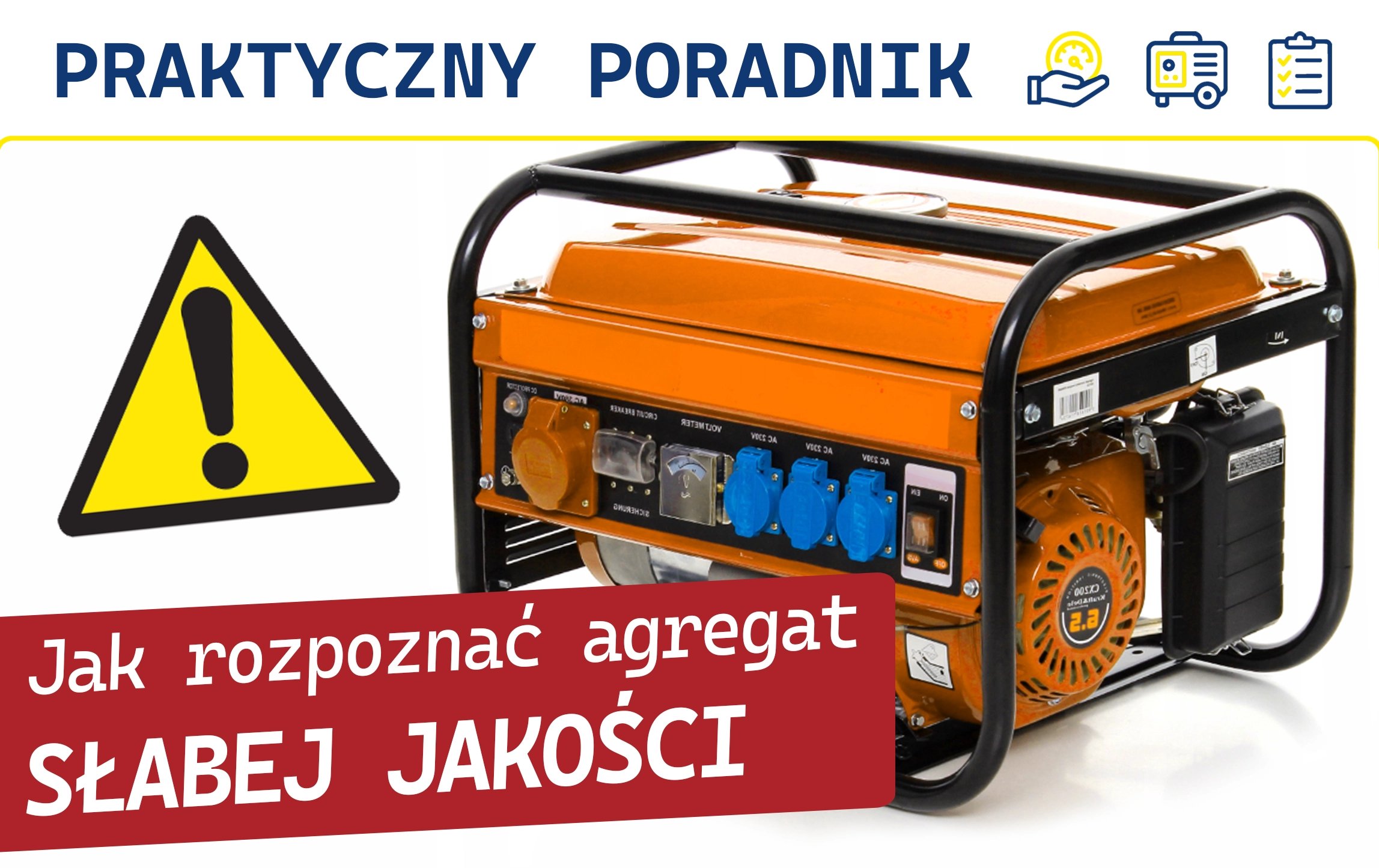
Counterfeits are also betrayed by overall build quality. Thin sheet-metal enclosures, poor fit of components, random socket placement, or lack of logically labeled protections are typical signs of low-quality units. Cost-cutting is also visible in cable insulation, frame quality, and alternator protection.
In branded generators every detail matters – from construction durability, through ease of use, to effective electrical and thermal protections. These are the elements that determine safe and long-term operation.
Real threat to user and equipment safety
Low-quality generating sets very often fail to meet applicable safety standards, and their technical parameters remain nothing more than marketing claims. Lack of proper protections, unstable voltage regulation, and poor insulation quality can lead to uncontrolled voltage spikes, overheating of installations, or even fire.
In practice, this means a real risk of electric shock, serious burns, and permanent damage to connected electrical and electronic devices. Repair costs often far exceed the apparent savings from buying a cheap counterfeit.
A price that should raise suspicion – why is it a warning?
If an offer for a generating set significantly deviates in price from the market standard for a given power range, exercise particular caution. Manufacturing a solid generator requires proven components, quality control, and compliance with strict technical standards. A drastically low price almost always means compromises that will sooner or later affect reliability and user safety.
Why buy generating sets from reputable manufacturers?
Purchasing a generating set is an investment in the safety of your home, business, or critical infrastructure. By choosing equipment from proven manufacturers and authorized distributors, you gain certainty of parameters, access to service, and real warranty coverage. Cheap counterfeits may tempt with price, but in the long run they create far more problems than benefits.

Damian Bartosiak
Responsible for service support of generator sets, diagnostics, inspections, and maintaining equipment readiness for business and institutional customers.